

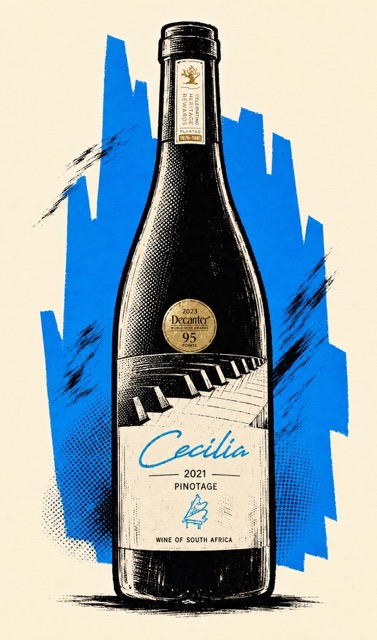
#503 Cecilia Old Vine Pinotage 2022

That difference isn’t luck. A European appellation is a legal boundary with a rulebook attached. Barolo fixes its vineyards between 170 and 540 metres, hillsides only, nothing facing north. So if warming pushes the best spot for Nebbiolo above 540 metres, the best possible Barolo is, by law, not Barolo. South Africa’s Wine of Origin system asks one thing: tell the truth about where the grapes came from. Plant what you like, where you like, and get the place demarcated afterwards.
Cerina van Niekerk has built a one-woman label on exactly that freedom. Master of Wine theory passed, a Mozart piano concerto instead of a launch tasting, and two blocks of fifty-year-old dryland bush vines on the Skurfberg and up in Piekenierskloof. This isn’t the highest Pinotage in South Africa. It’s something rarer: old and high at the same time.
TASTING NOTES
Aromas: The fruit refuses to pick a side. Bright red cherry and raspberry sherbet up top, then juicy mulberry and a touch of blackberry underneath, which is where most of the weight sits. That split is a family tree rather than an accident, because Pinotage is Pinot Noir crossed with Cinsault and you are smelling both parents in the same glass. Over the top, a sweet dried-herb puff: lavender blossom, somewhere in the rosemary neighbourhood. Stop there and you’d reasonably guess Shiraz. What gives it away is the savoury seam running underneath everything, smoked game meat, and you would be forgiven for calling it bacon. Think of it as a steak with cranberry drizzle, inverted: mounds of sweet dark fruit first, the smoke a long way beneath. And notice what isn’t there. No banana, no nail polish. Those come from the yeast and a hot, hurried ferment, not from the grape. Here it’s wild yeast in large open-top barrels, punched down by hand, fermenting at a gentle pace.
Palate: Remarkably fresh, which at fourteen percent is the surprise. Sour cherry and those raspberry touches sit alongside the juicier mulberry instead of being buried by it. No chocolate anywhere: fifteen to eighteen months in old, inert wood means no vanilla, no coconut, no toasty makeup, and nowhere for a thin wine to hide. There’s a gentle peppery spice that can’t be hung on a barrel, because there isn’t one, and the best guess is the cold nights up at Piekenierskloof. The tannin carries all the material and none of the aggression: whole berries, hand punch-downs, a basket press. The finish is black cherry rather than ripe black plum, with a last odd puff of freshly ground coffee that has no business being in a wine with no new oak at all.
TECHNICAL SPECS
Alc. 14% |
Submit your review | |
Wines that argue with their own reputation
#365 Snow Mountain Reserve Malbec
#451 Bellevue Atticus Cape Blend 2024
#445 Beyerskloof Traildust Cape Blend 2024
Recent Comments